
Last updated September 20, 2026
Free on-site gate assessment - hinges, posts, and your LiftMaster or Nice gate operator checked before anything is quoted
The assessment is free and the quote is the invoice.

Farm & ranch
 Before
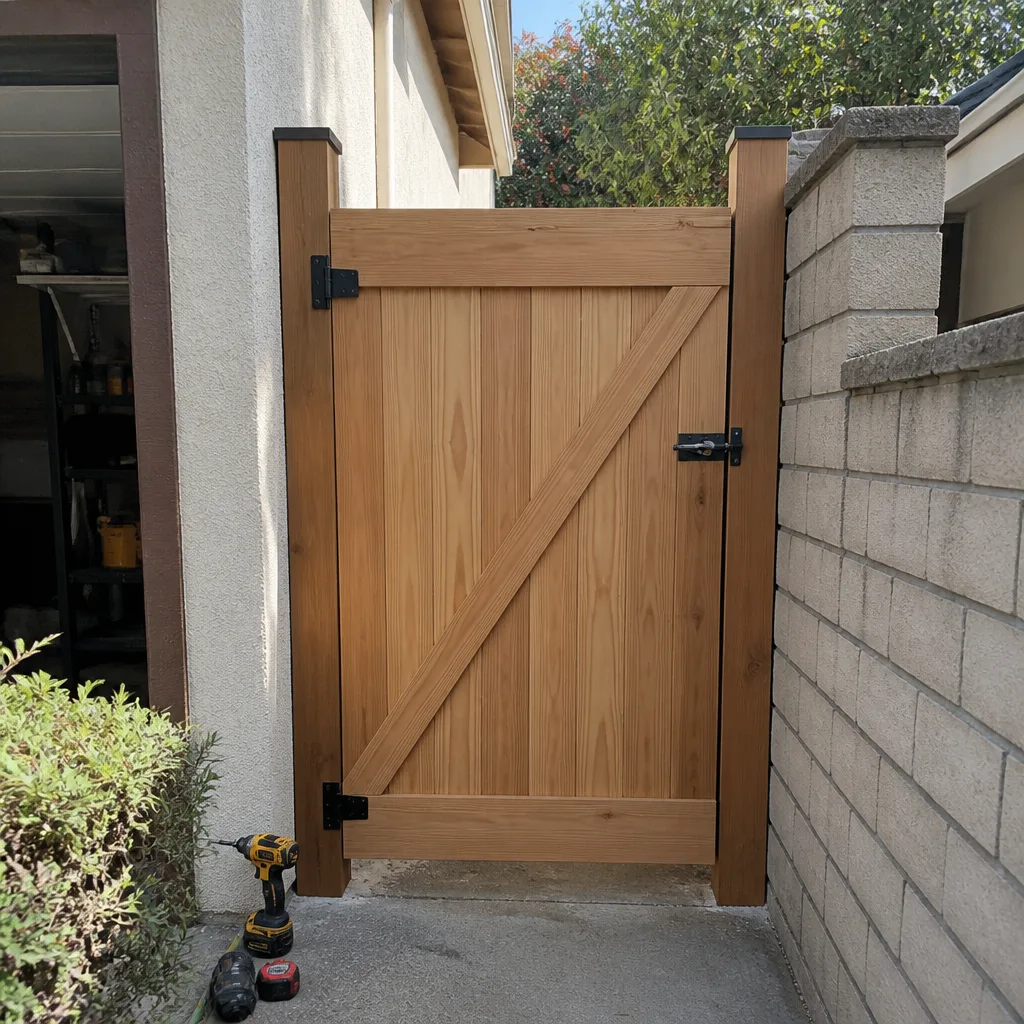 After
After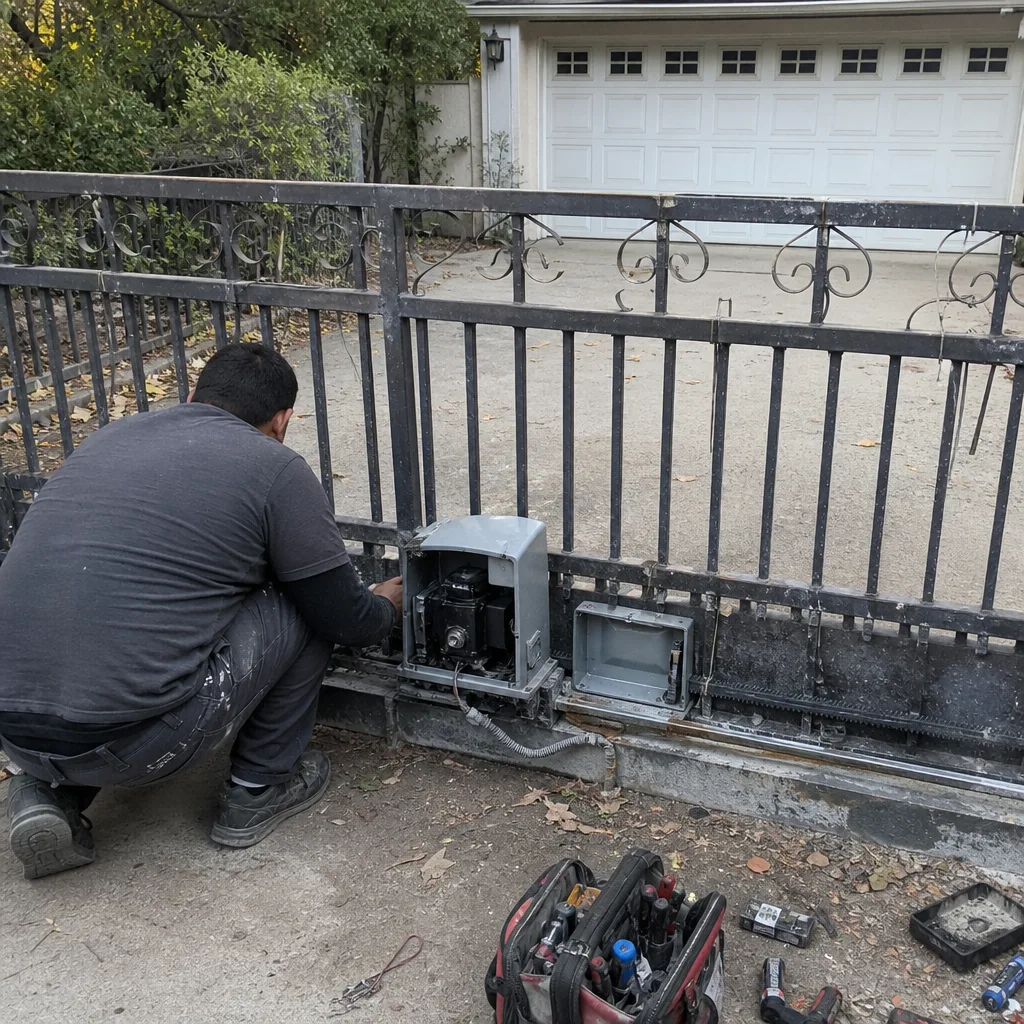 Before
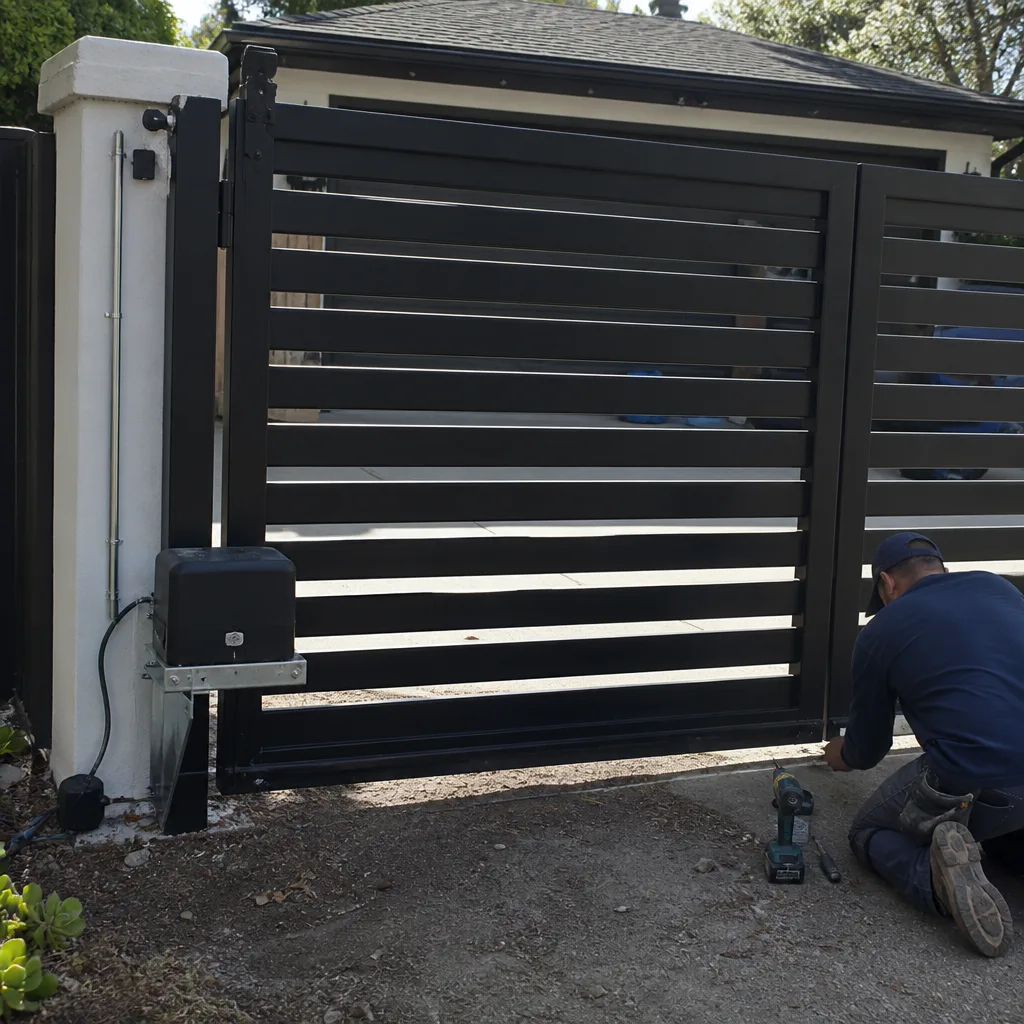 After
After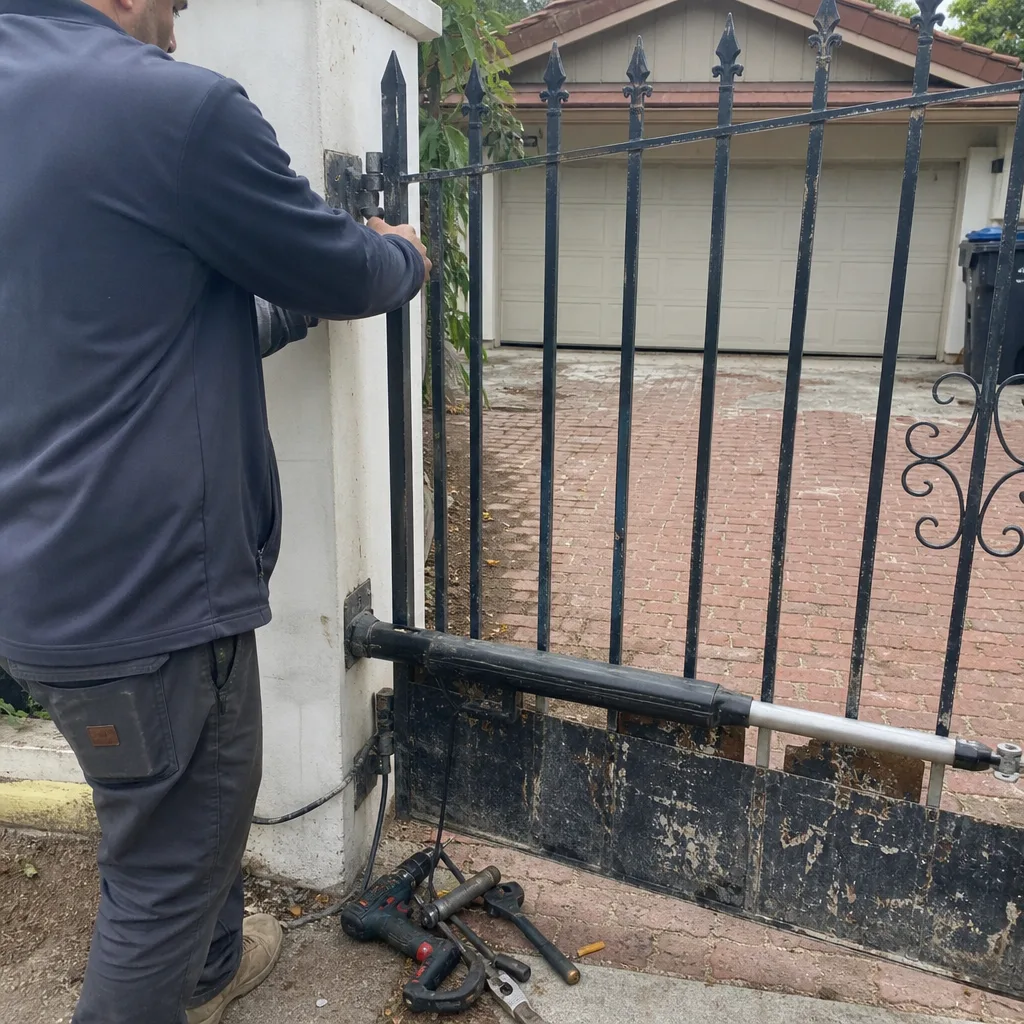 Before
 After
AfterGate Repair Maintenance Checklist for Pasadena Homeowners
Most printed gate maintenance checklists are to-do lists disguised as diagnostics. They tell you to lubricate the chain but not what a properly lubricated chain sounds like, so every homeowner checks the box and misses the problem. This guide is different. We’re going to show you how to record baselines: hinge gap measured at 3 millimeters on a specific date, chain tension noted in deflection inches, sensor alignment logged against a reference mark. Because in Pasadena, where Santa Ana winds load swing arms sideways and summer heat thins hydraulic fluid, a gate doesn’t fail suddenly. It drifts. And drift is only visible when you have a number to compare against.
Quick Answer
A Pasadena gate maintenance checklist works when it records measurable baselines, not binary yes/no tasks. The essentials: measure hinge gaps, chain or belt tension, and sensor alignment twice a year (spring and late fall), photograph the gate from fixed positions each time, and log every number in a simple notebook or spreadsheet so drift becomes visible before a $600 motor burns out. Most homeowners can handle lubrication and visual inspection safely; tension adjustments, limit-switch work, and hydraulic service need a trained hand.
Table of Contents
- Why Baselines Matter More Than Checkboxes
- The Pasadena Maintenance Calendar: When to Check What
- Three Maintenance Tasks You Can Safely Do Yourself
- Four Tasks That Need a Technician
- How to Photograph Your Gate for Drift Detection
- Creating a Home Maintenance Log That Any Technician Can Read
- Baseline Numbers by Gate Type: Swing, Slide, and Cantilever
BeforeAfterWhy Baselines Matter More Than Checkboxes
“Check the hinges” is useless advice. Check the hinges against what? A hinge that has worn from 2 millimeters of gap to 5 millimeters over eighteen months is telling you something specific: the gate leaf is settling, the post may be shifting, or a bearing is failing. But if you never wrote down the original 2 millimeters, the 5-millimeter reading just looks like “hinges are fine, gate still opens.”
We see this pattern constantly in Pasadena. A homeowner calls because the gate suddenly won’t close. The technician arrives, opens the motor housing, and finds the limit switch was compensating for a sagging hinge for months before the motor finally overheated. The repair is now a motor replacement instead of a hinge adjustment. The difference between a $180 hinge fix and a $680 motor replacement is often just whether someone recorded a number eighteen months earlier.
So here’s the core principle: every checklist item on this page should produce a number, a photograph, or a written note that you can compare against the next time you check. Not “lubricated chain: done.” Instead: “Chain deflection at midpoint: 1/2 inch. Sound: quiet, even. Lubricated with white lithium grease, 4/12.”
That’s how commercial access-control technicians work. They don’t check boxes. They record readings so the next technician, or the next maintenance cycle, has something to measure against. Your residential gate in Pasadena deserves the same treatment, because the failure modes here are predictable and slow. Heat, wind, and the fine dust that blows through the foothills all act gradually. Baselines are how you see gradual before it becomes expensive.
The Pasadena Maintenance Calendar: When to Check What
Pasadena’s climate does two specific things to gates. First, the Santa Ana winds, typically October through March, push hard against broad swing-gate leaves and stress the hinge pins, the arm bracket, and the operator’s internal gearing. Second, summer temperatures that regularly sit above 95 degrees thin out hydraulic fluid and soften grease, which changes how a gate moves and how much current the motor draws. A gate that runs fine in February can struggle in August, not because anything broke, but because the fluid got thin and the motor is working harder.
Here’s a maintenance schedule built around those two realities:
- Late October to early November: Full baseline check before Santa Ana season. Measure hinge gaps, chain tension, belt deflection, and sensor alignment. Photograph everything. Verify the manual release works. This is your pre-wind-season record.
- Mid-December to January: Walk-around inspection after the first few Santa Ana events. Look for loose fasteners, new paint cracks around hinge plates, or any change in how the gate sounds. Tighten what’s safe to tighten. You don’t need to re-measure everything, but look for movement.
- March to April: Post-wind-season check. Re-measure hinge gaps and chain tension against your October baseline. Any change over 2 millimeters in hinge gap or more than 1/4 inch in chain deflection means something shifted and needs attention before the gate gets worse.
- June to July: Heat-preparation check. If you have a hydraulic operator, listen for a sluggish or whining gate on hot afternoons. Lubricate pivots and rollers. Heat accelerates wear on any component that is already marginal, so this is the time to catch a failing bearing before it locks up.
This four-point annual rhythm fits Pasadena’s actual weather patterns. It also spreads the work so you’re not trying to do everything in one Saturday. Each session should take under 30 minutes once you know your baselines.
Three Maintenance Tasks You Can Safely Do Yourself
Let’s be honest about what a homeowner should and shouldn’t touch. Gates are heavy. A swing gate leaf can weigh 300 pounds or more. The motor, springs, and tensioning hardware store enough energy to break bone. So the dividing line is simple: if a task requires loosening a tensioned component, climbing onto the gate, or working with line voltage, it belongs to a professional.
These three tasks are safe for most homeowners with basic tools:
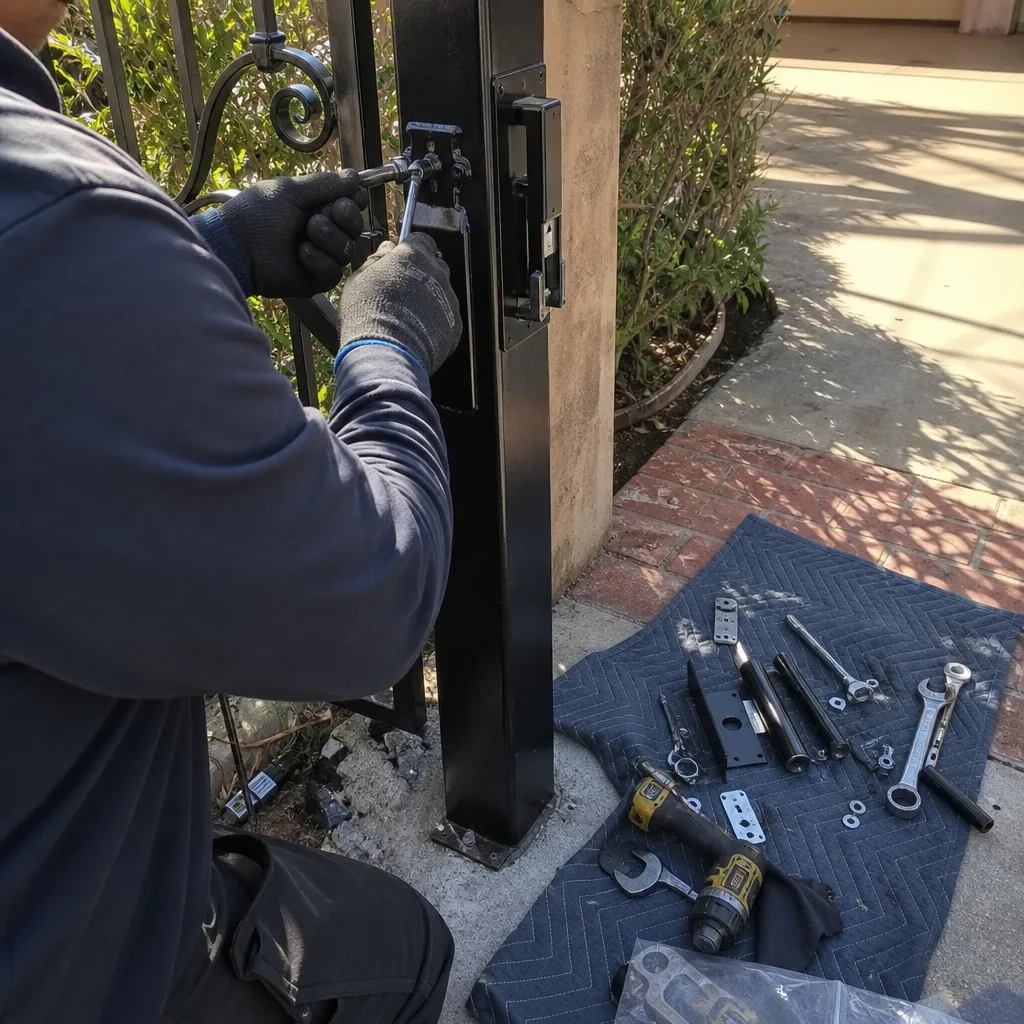
- Lubrication of non-tensioned moving parts. Pivot points, hinge pins, and roller wheels take spray white lithium grease or a dry PTFE lubricant. Apply, work the gate through a full open-close cycle, wipe off excess. Record what you lubricated and the date. Do not lubricate a chain without knowing what the manufacturer specifies; some chains run dry by design.
- Photo-eye cleaning and basic alignment check. The photo-eye is the small infrared sensor pair mounted near the bottom of the gate opening. Wipe the lenses with a dry cloth. If the gate reverses or refuses to close, check that both eyes are pointed at each other and that no plant growth has encroached on the beam path. In Pasadena, bougainvillea and ivy are frequent culprits.
- Track and roller cleanup (slide gates). With the gate in the open position and the motor disconnected from power, use a stiff brush or leaf blower to clear the track of gravel, leaves, and the fine dust that settles after wind events. Look for dents or spreading in the track. A bent track section is a number: measure the gap between track walls at several points and note any variance.
Every one of these tasks produces a recordable observation, and we cover more guides & resources on doing it right. That’s the point. You’re not just cleaning; you’re measuring and documenting so the next check has context.
Four Tasks That Need a Technician
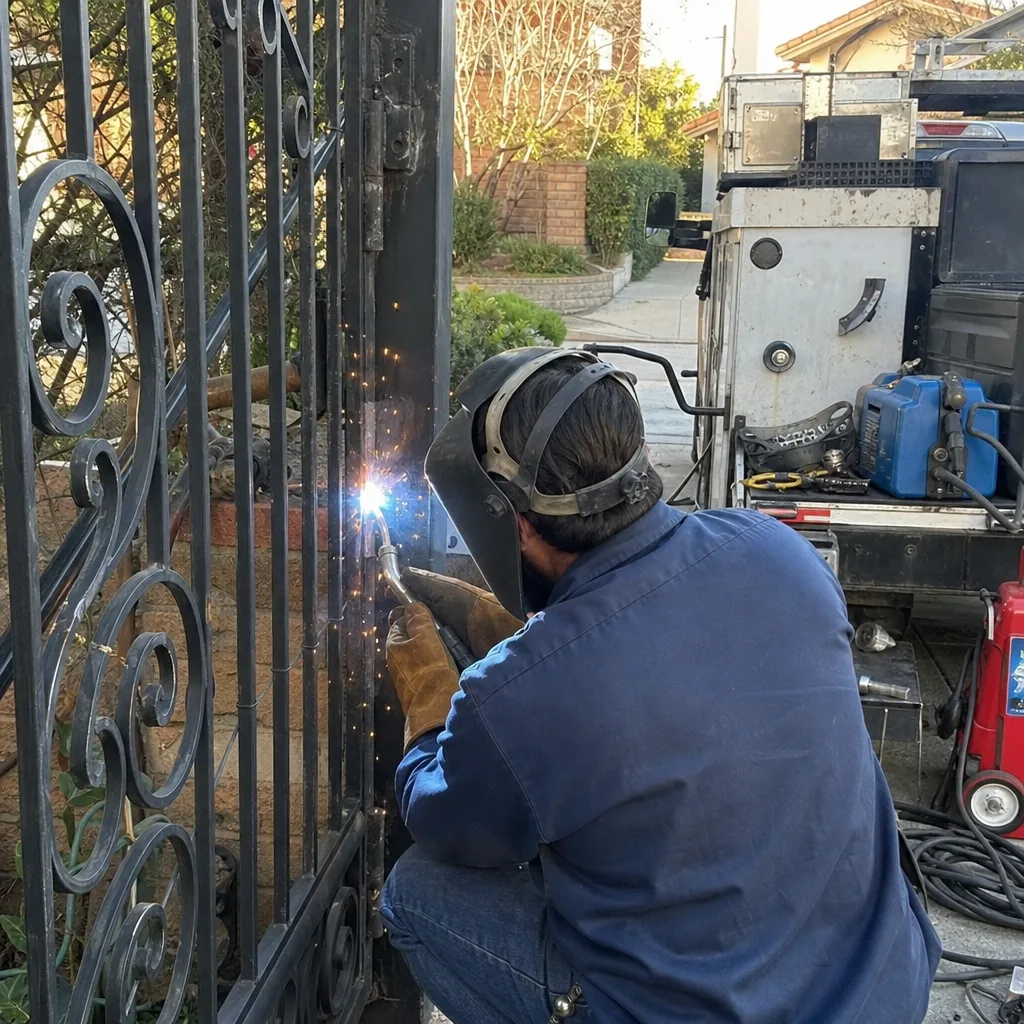
Some maintenance tasks carry real risk and should not be attempted without training and proper tools. We say this as gate technicians who see the results of brave DIY attempts: the injury risk is significant, and the cost of a failed repair usually exceeds the cost of professional service.
- Chain or belt tension adjustment. Chain tension affects motor load and limit accuracy. Overtensioning a chain can snap a sprocket or wreck a gearbox; undertensioning lets the chain jump and bind. The adjustment requires knowing the manufacturer’s deflection spec for that specific operator, and the measurement is done under specific conditions. A mistake here turns a $150 adjustment into an $800 operator replacement.
- Limit-switch setting or reset. The limit switch tells the motor where to stop. It sits inside the operator housing next to live electrical connections. Setting it wrong means the gate either slams into its end stops or fails to close fully, either of which can burn out the motor. This is a 15-minute job for a technician with a multimeter and access to the wiring diagram.
- Hydraulic fluid service. Hydraulic operators use fluid that degrades with heat cycles, and Pasadena summers generate a lot of heat cycles. Checking fluid level is simple; changing fluid, bleeding air from the system, and setting pressure relief valves is not. Air in a hydraulic line causes jerky, unpredictable gate motion, which is a safety hazard for anything in the gate’s path.
- Gate leaf realignment or hinge replacement. If your baseline measurements show a hinge gap change of more than 3 millimeters, the gate leaf needs realignment. That means supporting the weight of the gate, possibly removing it from its hinges, and resetting the geometry. This is not a one-person job and not a job for a car jack and hope.
For any of these, the right move is to call our Gate Repair services in Pasadena. A good technician will show you the readings before and after, and hand you a written record of what was changed.
How to Photograph Your Gate for Drift Detection
A photograph is only useful for detecting movement if it’s taken from the same position every time, at the same distance, with the same framing. A casual snapshot from a different angle each season tells you nothing. A disciplined photo log tells you when a hinge gap opened up, when a post started leaning, or when a weld crack began propagating.
Here’s the method we use on commercial access control sites, adapted for a residential gate:
- Establish four fixed camera positions. Position 1: full gate from the street side, straight on, about 15 feet back. Position 2: close-up of the top hinge plate from a consistent angle. Position 3: close-up of the bottom hinge or the track rollers. Position 4: the operator and arm bracket, taken from the side.
- Mark your standing spot. Put a small paver or a chalk mark on the driveway where you stand for each position. Stand in the same spot every time. This is what makes comparison possible.
- Use the same camera and lens. Phone cameras are fine, but use the same phone and the same zoom setting. If you swap phones, re-establish your baselines.
- Include a reference object in close-ups. A coin, a 6-inch ruler, or a Sharpie mark on the gate frame gives the eye something to measure against when comparing images side by side.
- Store the images with dates. Name the files by position and date, like “hinge-top-2025-03-15.jpg.” Create a folder on your phone or computer. This is your drift library.
When a technician arrives at your house, these photos are gold. Instead of guessing whether that crack is new or has been there for years, they can look at last October’s image and see exactly when it appeared and how fast it’s growing. That’s the difference between a confident repair and an exploratory one.
Creating a Home Maintenance Log That Any Technician Can Read
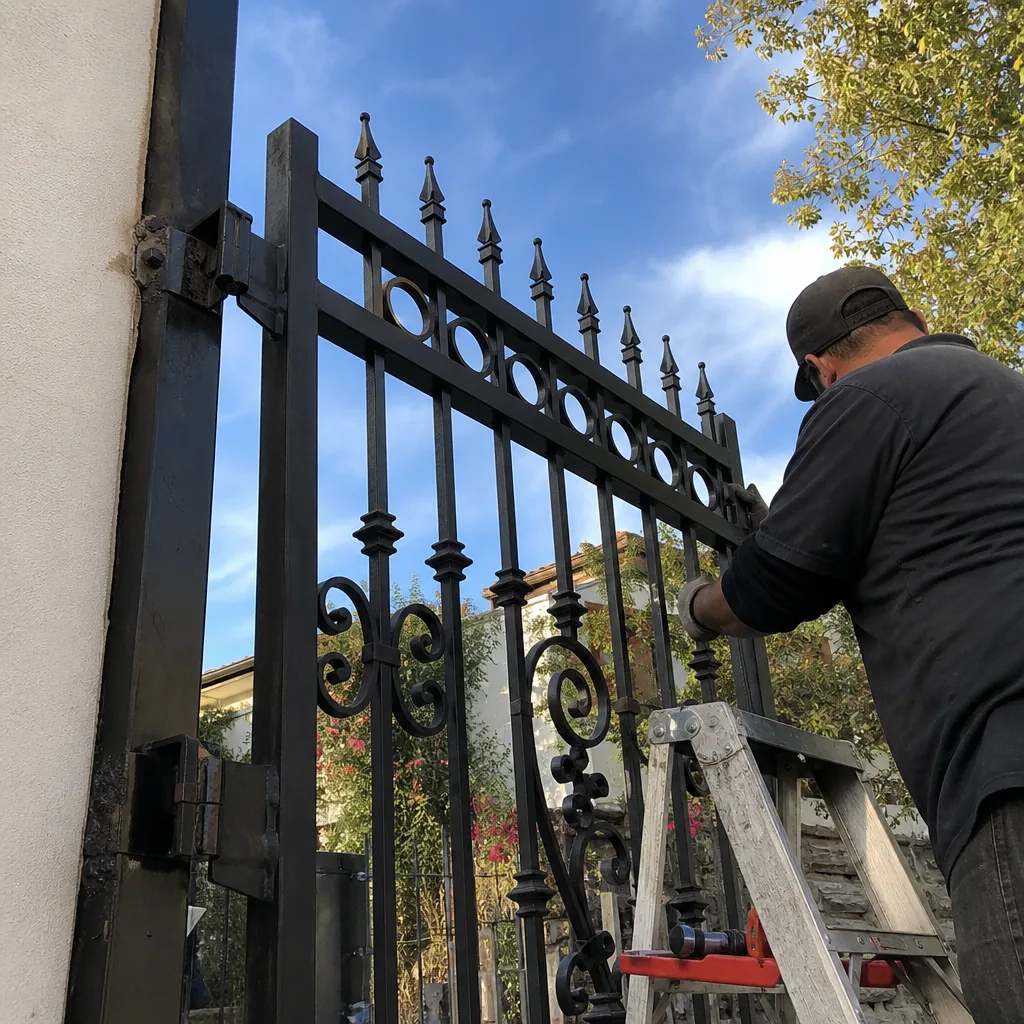
Commercial access-control sites keep a service log: a bound notebook or digital file where every visit, every adjustment, and every part replacement is recorded with a date, a reading, and a name. When a new technician arrives, they read the log before they open a panel. Nothing gets rediscovered. No one pays twice to learn what the last person already knew.
Your home gate deserves the same. It doesn’t need to be elaborate. A $4 spiral notebook and a pen will do. Here’s what to record, in order:
- Date and weather conditions. “March 14, clear, 72 degrees” gives context. A reading taken during a heat wave isn’t the same as one taken on a mild afternoon.
- Readings. Hinge gap in millimeters, chain or belt deflection in inches, any other number you measured. Write the numbers, not just “looks fine.”
- Actions taken. “Lubricated pivot points with white lithium grease.” “Cleaned photo-eye lenses.” Be specific about what you touched.
- Observations. “Gate sounds slightly different when opening, a low rubbing noise near the bottom hinge.” This is where you capture the things that don’t have a number yet.
- Next scheduled check. Always end with the next date. It turns maintenance from a good intention into an appointment.
When you eventually need a gate repair in Pasadena, hand this log to the technician. They’ll be able to see the trendline. Hinge gap was 2mm, then 2.5mm, then 3.5mm. The gate is telling a story, and your log is the transcript.
Baseline Numbers by Gate Type: Swing, Slide, and Cantilever
Different gate designs fail in different ways, which means they need different baseline measurements. Here’s what to measure for the three most common residential gate types in Pasadena.
Swing Gates
A swing gate is a leaf on hinges, powered by an arm operator or an underground operator. The baseline numbers that matter:
- Hinge gap: measure the vertical gap between the hinge leaf and the gate frame at the top, middle, and bottom hinge. Record all three. A difference of more than 1 millimeter between the top and bottom hinge readings indicates uneven settling.
- Gate leaf clearance at the latch post: measure the gap between the free edge of the gate and the latch post when the gate is closed. This should not change. If it does, the leaf is sagging or the post is moving.
- Operator arm attachment: check that the arm bracket bolts are tight and photograph the bracket from the same angle each time. Santa Ana winds work these bolts loose on a predictable schedule.
Slide Gates
A slide gate travels horizontally on rollers or a track. Slide gates are common on narrower Pasadena lots where there is not enough room for a swing leaf to arc open.
- Track width consistency: measure the distance between the inside faces of the track at three points along its length. Track spreading or narrowing by more than 1/4 inch is a problem.
- Roller wear: photograph each roller wheel. Flat spots, shiny metal showing through the coating, or visible wobble when the gate moves all indicate replacement time.
- Chain sag (chain-driven slide gates): with the gate closed, press down on the chain at its midpoint. Measure deflection from a straight edge. Compare against the manufacturer’s spec, usually somewhere between 1/4 and 1/2 inch. Record the number.
Cantilever Gates
A cantilever gate rides on rollers and floats over the driveway opening with no track in the ground, which makes it popular where Pasadena’s older driveways have settled unevenly. The baseline:
- Gate-to-driveway clearance: measure the gap between the bottom of the gate frame and the driveway surface at both ends and the middle when the gate is closed. All three readings should stay consistent. Changes mean the support posts or the gate frame are moving.
- Roller alignment: photograph each roller carriage. Look for the gate frame riding off-center on the rollers. A cantilever gate that drifts sideways on its rollers will eventually bind.
These are the numbers that tell you whether your gate is healthy or quietly failing. Write them down, keep the log, and compare every six months.
Common Mistakes to Avoid
- Lubricating a chain that should run dry. Not all chains want lubricant. Some manufacturers specify dry operation, and adding grease to a dry chain turns it into a dirt magnet that accelerates wear. Check your operator manual before you spray anything.
- Treating photo-eye problems as motor problems. When a Pasadena gate won’t close, the photo-eye is misaligned or blocked more often than the motor has failed. Clean the lenses and check the beam path before assuming the worst.
- Ignoring a slowly changing sound. Your ears are diagnostic equipment. A gate that gradually gets louder, develops a squeak, or starts hesitating at the same point in its travel is telling you something specific. Note the sound in your log, don’t just “get used to it.”
- Processing a power outage as a gate failure. After a Pasadena wind event knocks out power, some operators need a manual reset or need the limit settings re-verified. If the gate behaved weirdly after an outage, check the simple things before calling for repair.
- Waiting until the gate stops working to look at it. The most expensive repairs are the ones that gestated for two years while the hinge gap grew, the motor worked harder, and the current draw climbed. A semiannual 20-minute check catches these. Replacement costs are avoidable with baseline discipline.
When to Call a Professional
Call when a baseline moves. If your hinge gap widened by more than 2 millimeters since last check, call. If your chain deflection is off spec by more than 1/4 inch, call. If the gate reversed on its own without an obvious obstruction, call. If you smell electrical burning, hear grinding from the operator, or see visible sparking, shut the gate off at the breaker and call immediately. These are not maintenance items; they are failures in progress. A trained technician can identify the cause, make the repair, and give you a written record of what changed. Vance Gate Repair Pasadena home offers free estimates for Pasadena homeowners, and every visit includes a documented photo record. Call (626) 624-4196 to schedule a check.
Frequently Asked Questions
Twice a year is the minimum: once in October before the Santa Ana wind season starts, and once in April after the worst of the winds have passed. Add a light summer check in July if you have a hydraulic operator, because Pasadena heat changes how hydraulic fluid behaves. Each check takes under 30 minutes if you maintain a baseline log.
Most Pasadena gate repairs fall between $150 and $700 depending on what failed. A hinge adjustment might run $120-$200, a photo-eye replacement $180-$280, a circuit board replacement $350-$650, and a swing-gate motor replacement $600-$1,200 depending on the brand and whether the arm bracket is intact. Every job should carry a written price before work starts. For an exact quote on your gate, call (626) 624-4196 for a free estimate.
Yes, for non-tensioned moving parts like pivot points, hinge pins, and roller wheels. Use white lithium grease or a dry PTFE spray, apply sparingly, wipe off excess, and record the date in your log. Do not lubricate chains or belts without checking the operator manual, and do not open the operator housing if you are unsure about live electrical connections.
The earliest signs are behavioral, not mechanical: slower than normal travel speed, a gate that stops partway and reverses, or a motor that runs but sounds strained. If you have a baseline log, compare your current readings against previous ones. A motor that has to work harder because of a worn hinge or a misaligned track will fail sooner than one running within tolerance.
What does a full gate installation in Pasadena include?
A complete installation includes the gate fabrication or prefabricated gate delivery, all posts and mounting hardware, the operator and arm or track system, photo-eye sensors, and the power and control wiring run to code. Reputable installers include safety edges, proper ground clearance, and a written record of all settings. Every installation should come with a written price before any work begins.
Yes. A complete gate installation includes the electrical run from your panel to the operator, properly sized for the motor’s current draw, and the installation of photo-eyes and safety edges so the gate stops or reverses if something crosses its path. This is not optional add-on work; it’s part of making the gate safe to operate. For details on your specific property, call (626) 624-4196.
Yes. We service and repair all major gate automation brands including LiftMaster, DoorKing, Elite, and Mighty Mule, among others. We never steer a homeowner toward replacing a motor that can be repaired. If your operator is serviceable, we’ll give you a written price to fix it. If it’s genuinely beyond repair, we’ll show you the evidence and give you a written price for replacement too.
The Bottom Line
A maintenance checklist without baselines is a to-do list, not a diagnostic tool. The whole point of checking your gate is not to confirm it still opens; it’s to record the numbers that show whether it’s wearing evenly, drifting slowly, or holding steady. Here in Pasadena, where wind season follows fire season and summer heat tests every moving part, a semiannual measurement routine will catch small problems before they become $600 motor replacements. Write down your hinge gaps, photograph your operator, and keep the log where you can find it. When you need a professional to interpret the trendline or make a repair, our gate motor and opener service in Pasadena is here with a written price before any work starts.
Call (626) 624-4196 for a free estimate, or schedule a gate repair in Pasadena today.
Written by Adrian Vance, Owner at Vance Gate Repair Pasadena, serving Pasadena since 2014.